Ribbit
A Gamified Speech Therapy App for Kids with Communication Disorders
Year
2026
Duration
5 Months
Role
UX Designer
Team
4 Members
Tools
Certifications
01
The Challenge
What is a Communication Disorder?
A communication disorder (formerly known as a speech impediment) is an impairment in a person's ability to receive, send, process, or comprehend concepts, which can affect speech, language, or hearing.
42M
People affected in the US
1 in 6
People have a communication disorder
5-10%
Of children have speech sound disorders
Source: NIH, 2026
What is an SLP?
A Speech-Language Pathologist (SLP) is a licensed healthcare professional who diagnoses and treats communication and swallowing disorders. They work with children and adults on speech sounds, language development, fluency, and voice quality.
Over 5 months, our interdisciplinary team designed Ribbit, a gamified speech therapy app that makes practice engaging for children while providing therapists and parents with tools to track progress.
The Problem
Children with communication disorders often struggle with traditional therapy methods that feel repetitive and boring. Parents lack accessible tools to support practice at home between sessions.
The Solution
Ribbit: a frog-themed mobile app that transforms speech exercises into interactive games, with a companion physical toy and a dedicated portal for speech-language pathologists.
Key Challenges
Engagement Gap
Traditional therapy exercises feel like homework — repetitive and unengaging for young children.
Access Barriers
Many families lack access to frequent in-person therapy sessions due to cost or location.
Practice Consistency
Home practice is crucial for progress but often neglected without engaging tools.
Progress Visibility
Parents and therapists struggle to track improvement between sessions.
02
Research & Discovery
Our team's unique composition — 2 speech pathology majors, 1 CS student, and myself as UX designer — gave us direct access to clinical expertise. We conducted ethnographic and anthropological research, interviewing parents about their children's therapy experiences and identifying key gaps in motivation and early intervention.
Research Methods
Literature Review
Evidence-based speech therapy techniques and best practices
Parent Interviews
Conversations with parents about their children's therapy experiences and challenges
Competitive Analysis
Reviewing existing speech apps, physical toys, and patents to identify gaps
Benchmarking Analysis
Analyzing successful therapy tools and gamification patterns in healthcare
Competitive Landscape
We analyzed existing speech therapy apps, physical therapy toys, and relevant patents to understand the current market and identify opportunities for innovation.
Digital Apps
Most apps lacked clinical backing or failed to maintain long-term engagement with children.
Physical Toys
Existing therapy toys were often clinical-looking and didn't connect to digital progress tracking.
Patent Research
Reviewed existing patents to ensure our approach was novel and to identify proven interaction patterns.
Key Insights
Repetition is Essential
Children need consistent practice, but motivation wanes quickly without engaging mechanics.
Visual Feedback Matters
Kids respond better to immediate, visual rewards than abstract progress metrics.
Parent Involvement is Key
Parents who understand exercises can better support practice at home.
Clinical Validity First
Apps must align with evidence-based therapy techniques to be effective.
03
Design Process
The frog theme wasn't random — it was strategically chosen based on our research and the needs of our users.
Why a Frog?
Natural Vocalization
"Ribbit" naturally encourages children to vocalize and practice sounds.
Progress Metaphor
Hopping from lily pad to lily pad visualizes progress through therapy.
Universal Appeal
Friendly to all genders and age groups, avoiding gendered stereotypes.
Growth Symbolism
A tadpole growing into a frog mirrors a child's speech development journey.
Core Features
Daily Lessons
Structured articulation exercises gamified as mini-adventures
Interactive Games
Voice-based games that make repetitive practice feel like play
Progress Pond
Visual journey showing the child's advancement through therapy
SLP Portal
Dashboard for speech-language pathologists to customize and track
04
The Solution
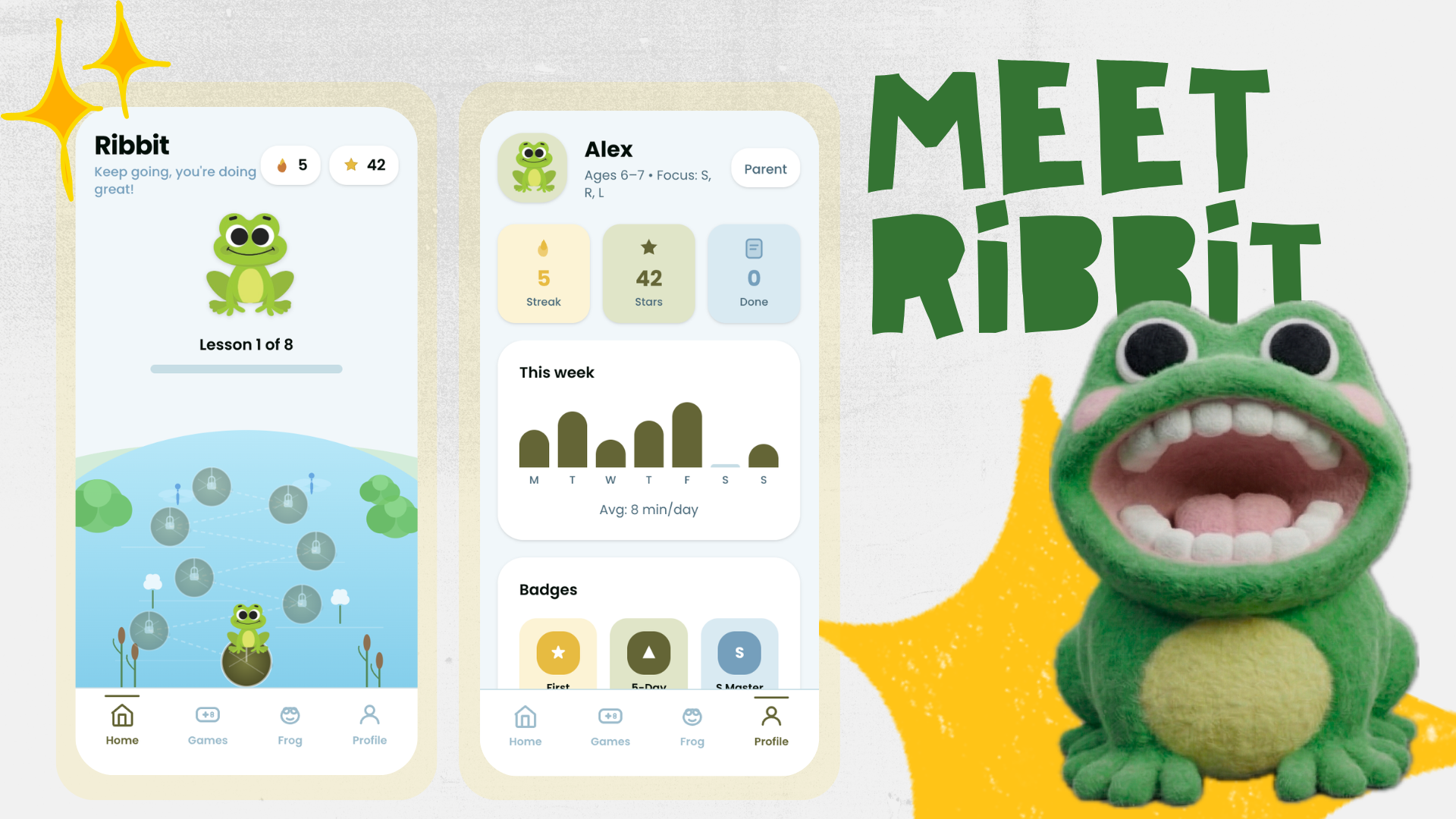
Ribbit combines a child-facing mobile app with a specialist portal for speech-language pathologists. The app features interactive exercises, progress tracking, and a companion physical toy that bridges digital and tangible play.
Ribbit app screens with the physical companion toy
For Children
- Gamified exercises
- Frog character progression
- Badges and rewards
- Voice-based interactions
For Parents
- Progress dashboard
- Practice reminders
- Session summaries
- At-home guidance
For Therapists
- Custom exercise plans
- Client management
- Progress analytics
- Session notes
05
App Walkthrough
Interactive prototypes built on Vercel showcasing the core user flows — from onboarding to daily lessons, games, and the SLP specialist portal.
Onboarding Flow
Child onboarding — setting up profile and preferences
Daily Lesson
Structured daily exercises with visual progress tracking
Interactive Games
Voice-based games that make practice feel like play
SLP Specialist Portal
Dashboard for speech-language pathologists to manage clients and track progress
06
Physical Companion
Ribbit extends beyond the screen with a physical plush frog companion. The toy bridges digital and tangible play, making therapy practice feel more personal and engaging for children.
The Ribbit plush companion — bridging digital and physical play
Tangible Connection
Children bond with physical toys, creating emotional investment in their therapy journey.
Practice Partner
The frog becomes a "practice buddy" that children can talk to during exercises.
Reward System
Earning accessories for the physical toy motivates continued engagement.
07
Results & Reflections
After 5 months of research, design, and iteration, Ribbit was awarded 3rd place at the Purdue Innovation and Design Challenge for its novel approach to speech therapy.
Competition Outcome
3rd
Place Winner
5
Months Development
4
Team Members
My Contributions
- Led UX research and user testing sessions
- Designed core interaction patterns and user flows
- Created high-fidelity prototypes in Figma
- Built interactive prototypes on Vercel
- Contributed to final pitch presentation
Key Learnings
- Interdisciplinary collaboration amplifies impact
- Designing for children requires humility and testing
- Healthcare UX has unique constraints to balance
- Long-term projects allow deeper research and iteration
The Team
Ribbit was made possible by an interdisciplinary team of 4 members combining clinical speech pathology expertise with design and technical skills:
- UX Designer (Me): Designed the interactive prototype, conducted ethnographic research and field notes, built pitch presentations for both rounds of judging.
- Industrial Designer: Engineered CAD prototypes for the physical companion, conducted field notes and ethnographic research, built the financial model.
- 2 Speech Pathology Experts: Conducted ethnographic research and field notes, conducted a patent and benchmark analysis, communicated ideas and collected feedback from SLPs and Parents.
Next Journey
Explore More Journeys→